
- Tuesday to Saturday: 10:30 – 16:30
Sunday: 10:30 – 15:30
Closed on Mondays


VISITING BOX CARD
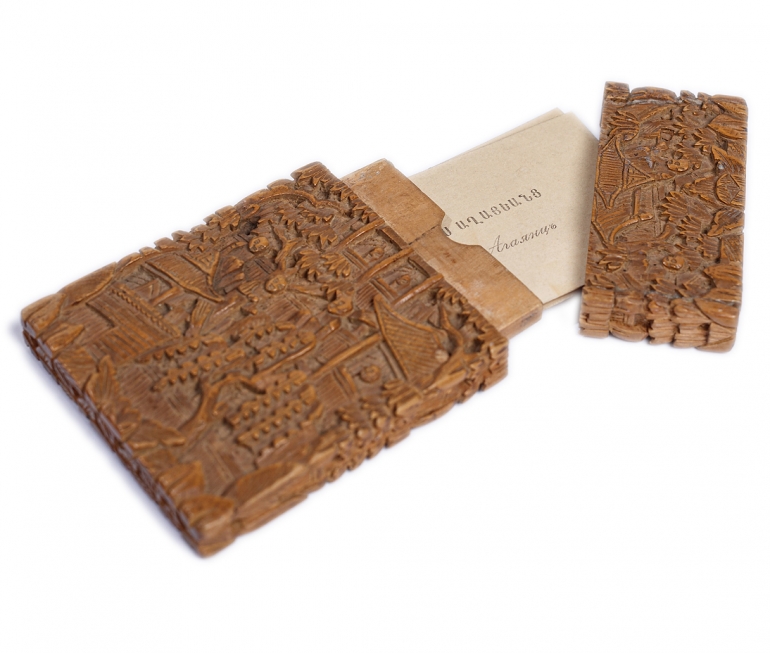
The box of visiting cards – made of sandalwood (Chinese: 檀香) – is one of the things that characterize Hovhannes Toumanian’s beautiful lifestyle. It has a square shape, consisting of two parts; a box and a removable lid. Dimensions: 10.6x6.5x1 cm, the lid: 6.5x3.3x1 cm.
This visiting card box is a typical sample of Chinese woodwork. The delicate, engraved composition that adorns its entire surface is notable for its artistry and manner of execution. It depicts men in pagodas (Chinese: 寶塔, bao ta "treasure tower", multi-story places of worship), surrounded by willows, reflecting the idea of the organic trinity Man-Nature-Faith.
This personal use item outlines the history of the development of woodwork in China, where it originated in 2nd millennium BC, and became widely known in the 14th century, during the Ming Dynasty.
The art of wood carving, closely intertwined with many branches of Chinese applied art, has been used in the art design of both Chinese cultic-palace and people’s everyday life, with elements of its ethnic culture.
But when and where did the visiting card come about.
According to historical evidence, the visiting card appeared in ancient China in the 3rd-2nd centuries BC. In the beginning, they were made of bamboo and wood, and later of silk and paper. By special order of the emperor, only the name and position of the Chinese official were marked with black ink on the red paper visiting cards. A visiting card was used to convey information about the owner in order to arrange a meeting with another person.
According to some historical sources, the visiting card appeared first in France in Europe, as a necessary cultural element of communication etiquette. The term "visiting card" comes from the French word "visite" (visit), the first official mention dates back to the 17th century, during the reign of Louis XIV. The monopoly on the possession of a visiting card initially belonged to the upper class of the population, over time it became widespread and became an obligatory attribute of the middle class, but was not common among the lower strata.
Making visiting cards was a unique art. The best masters of the time provided their luxurious design according to the owner’s preference. Visiting cards designed according to the standards of the time, indicating the best aspects of the owner, could determine a person's social status and success.
Printed visiting cards became more common with the advent of polygraphs. The first historical sample is preserved in Germany, which dates back to 1786.
Today, there are three types of visiting cards: personal (family), corporate and business.
Each of them - regardless of its specifics and nature of use - performs the function of transmitting contact details of a person or organization, field of activity or services provided to someone or future customers during business or personal meetings, conferences, negotiations or business trips.
Although the homeland of the visiting card is China, the visiting card box was born in Europe much later. Special boxes (wooden, ivory, metal, today also leather and plastic) were used to store visiting cards, which stood out for their unique design (ribbon, delicate jewelry details and engraving). Later, special booklets for visiting cards were produced. Their covers were usually facing with leather, decorated with beads, velvet or precious stones.
In the modern world, the variety of visiting cards and visiting card boxes proves that they have not lost their relevance and applicability.
The visiting card box was purchased from Toumanian’s family according to the act of December 4, 1980. The registration number is TTGG 853 / WB 914.
The co-authors of the article


Translated by Anahit Sringyan
