
- Tuesday to Saturday: 10:30 – 16:30
Sunday: 10:30 – 15:30
Closed on Mondays


Travel kettle
“Ohannes Agha had a travel box, inside it:
Plate, cup, spoon and other utensils,
to take with him to Kars, Akhaltsikhe and other places of hostilities.
He was constantly at war outside of Lori”.
Nvard Toumanian
“The childhood of Toumanian”
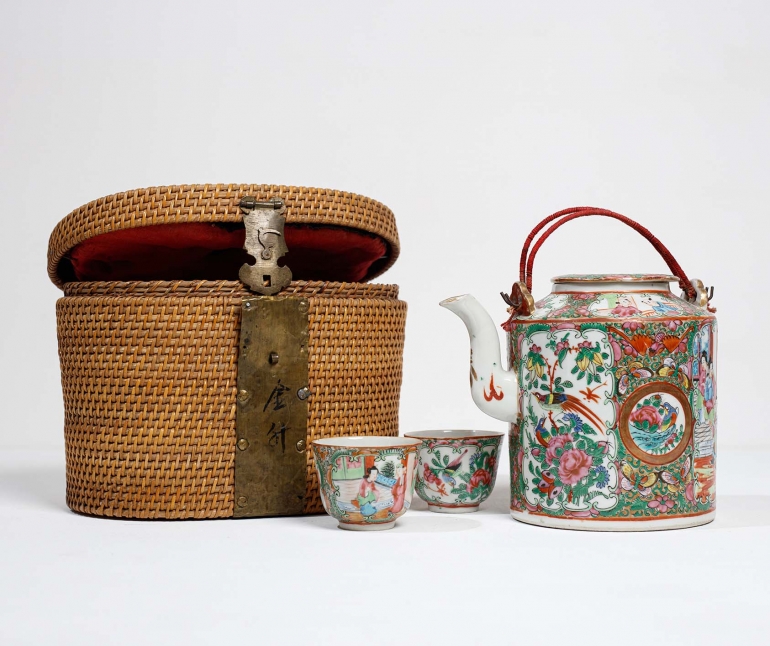
By a curious coincidence, Hovhannes Toumanian had a travel basket, just like his grandfather, the brave soldier Hovhannes Agha. It reveals one of the preferences of the poet-traveler. According to Toumanian, travel should be of great importance in the life of a creative person, as a great opportunity for his development and getting new impressions.
The poet said, "Travel opens a person's eye and heart." Not having the opportunity to travel, he got to know the world through books, but did his best to travel to every corner of his homeland. As he used to say, every writer must know his homeland.
One of the goals of the poet-traveler during his journeys on the path of a wise and experienced life was to be close to the people, their word and speech, to the source of his writings, to collect folklore materials.
This travel basket, which stands out among the poet's personal belongings, assumed that the donor, Mamikon Grigoryan, also chose the gift due to Toumanian's love for travel.
Toumanian's travel basket includes:
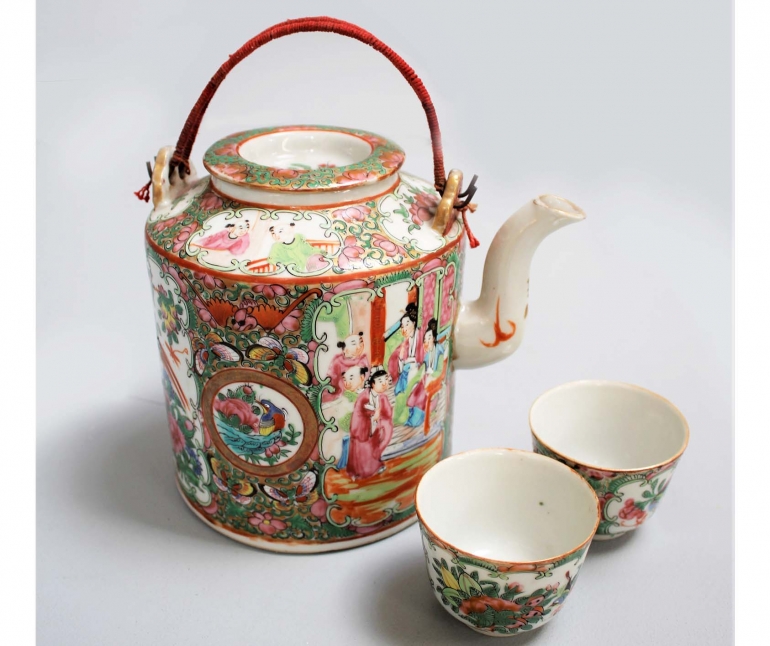
A porcelain teapot; height 16 cm, diameter of the floor - 16.5 cm, diameter of the neck - 7.5 cm, diameter of the mouthpiece - 8.5 cm, diameter of the floor - 5 cm.
The whole surface of the waist is surrounded by light relief polychrome illustration: the four rectangular medallions are framed by a circle of faded green spirals crowned with consecutive pink-green floral lace (festoons).
Everyday scenes of two medallions opposite each other represent images of men and women in blue-pink clothes in the interior of the palace. The other two depict flowers and a rose bush on a white background, accompanied by colorful birds. The fields between the medallions stand out with their illustrations. In the center of the stylized floral ornament on a gold background are round medallions depicting a wild rose bush on a white background, framed by a gold frame around which four butterflies with multi-colored feathers are depicted. Above them are red bats. The slightly sloping shoulder surface is decorated with similar images. The four oval medallions, in turn, present floral-everyday scenes with the image of two men.
On opposite sides there are porcelain tips, each of which has two holes, through which two flexible wires wrapped with red thread pass through the handle of the teapot. The part of the white nose on the upper part of the waist, which is twisted towards the tip, is decorated with a painting. The inside of the teapot is glazed. A part of the writing made of ink, has been preserved on the outer surface of the floor. "To dearest Hovhannes, from Mamikon Grigoryan, 6. 02. 1919 ..." - the continuation is illegible.
The teapot has a muzzle cup. It resembles a small deep plate, the bottom of which is decorated with a red rose painted on a white base, lined with floral patterns, pink roses on a golden base, and stylized leafs. The inside of the plate is glaze. Apparently, the muzzle cup also served as a sugar bowl.
Two porcelain cups, height: 5.5 cm-5.7 cm, diameter: 7 cm, diameter of the base: 3.2 cm, 3.5 cm, without handles, plates.
The cups have the shape of a truncated cone with a small base (double) extending from the round base to the lip.
The inside is glazed in white color, and on the entire outer surface we see a pattern corresponding to the illustrations of the kettle. In two table shape medallions on the white base there are scenes depict human figures and a rose bush accompanied by a bird.
The cups differ from each other only with a slight color shade. One of them is dominated by crimson (reddish-yellow).
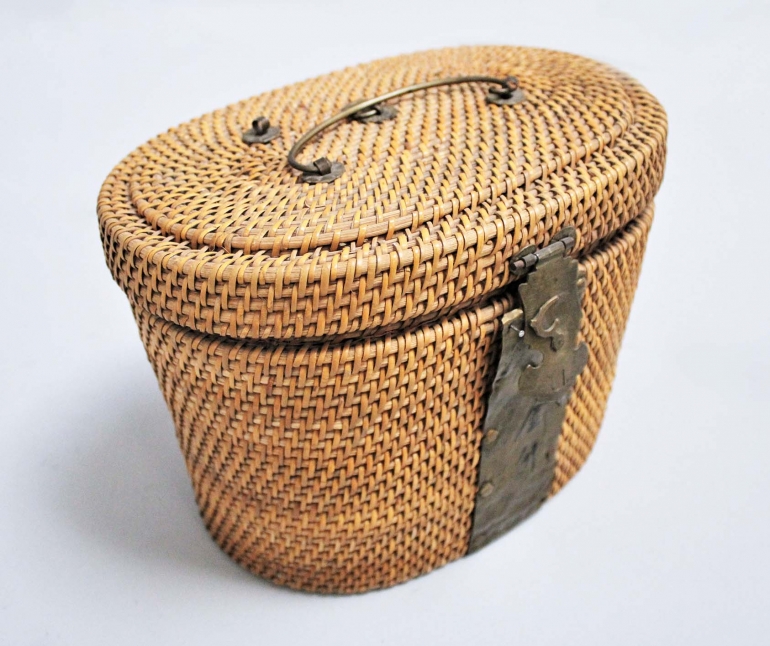
Tea dish case, height: 17 cm, base diameter 16.5 x23.5.
It is a basket made of slats and straw, with an oval base and a reclining lid.
On the lid and floor the "egg-shaped" woven slats are arranged in concentric circles, and on the surface of the waist, one on top of the other, with a column, through which the straw thread passes, forming diagonals.
Attached to the center of the cover is a circular plate with a ring, to the right and left of which are attached 4 ears, through which pass two arched wires that serve as handles. One handle has not been saved.
The lid is attached to the basket by two rings passing through metal ears.
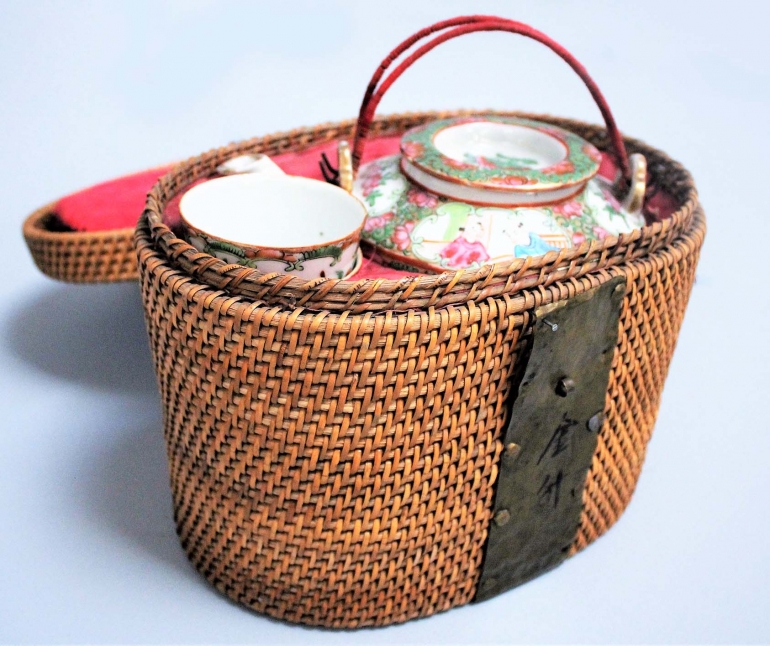
In the central part of the basket’s front side – with the help of nails with round heads – a copper tape is attached along the entire height of the basket, part of which goes to the floor. The latter is stamped with two hieroglyphs (jīn shēng 金 升), probably a brand name. 金 and 升 have no any meaning, separately 金-gold, also the Qing of the Qing dynasty is written with the same hieroglyph; 升- to ascend.
A lock is attached to the lid, on which the hook is attached to the hinge. Inside it an oval pad, made of bright pink fabric with a dark purple lining, is attached to the floor with a metal clip.
Inside the basket there are sockets for the kettle and cups, covered with a bright pink fabric.
Chinese porcelain production has a thousand-year history. It was most developed and improved during the Qing Dynasty (1644-1912), when several Chinese porcelain "families" were already formed: "green family", "yellow family", "black family" and "pink family".
The main production of porcelain was concentrated in the city of Zhendechen.
Considering the color and pictorial designs of the collection, also the inscription on the plate, we can state that it was created during the Qing Dynasty (XVII-XX centuries) and belongs to the "pink family" of Chinese porcelain (Chinese fen cai 粉彩), which often referred to as "Chinese Rococo". It got its name due to the predominant colors in the composition – light pink and red (crimson). The Chinese borrowed the technology to get pink paint from the West. In 1650, the Dutch chemist Andreas Cassius created a pink dye based on colloidal gold (gold crystals). The porcelain items of this family are colorful, decorated with landscapes, household, palace and mythological scenes, which are depicted in various medallions. The sketches were made by famous Chinese artists. It is noteworthy that Chinese porcelain was equated with gold and was considered an expensive jewelry. For a long time it was called the "white gold" of China.
On September 25, 1952 Toumanian's widow Olga Toumanian presented the whole collection to the Museum (act N 5):
The collection is registered in the main fund of the museum TTGG148/WB198.
The co-authors of the article

Translated by Anahit Sringyan
