
- Tuesday to Saturday: 10:30 – 16:30
Sunday: 10:30 – 15:30
Closed on Mondays


“WHITEBOARD” or…
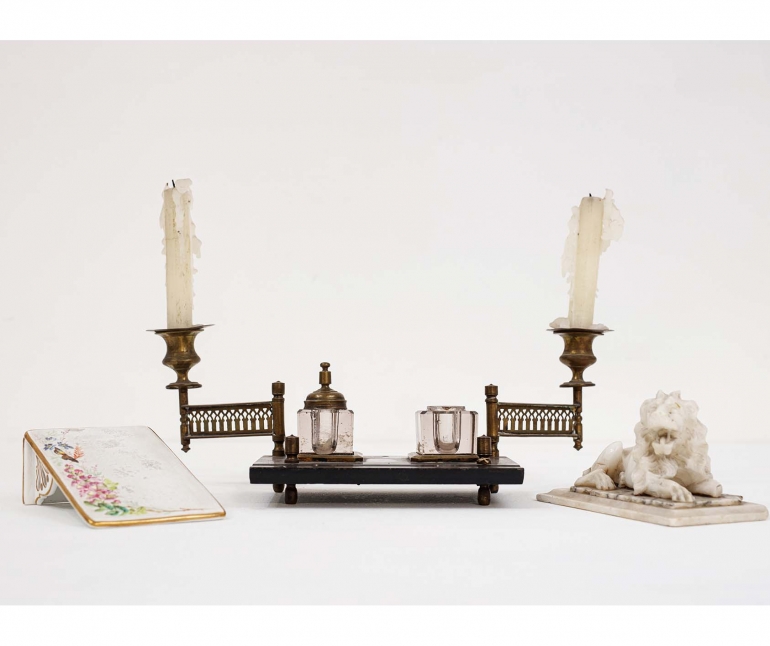
Hovhannes Toumanian had an exceptional gift of enjoying art. The poet "took" from the Haven the delicate sense of seeing beauty and the unique ability to appreciate it, along with many other graces and lavish gifts.
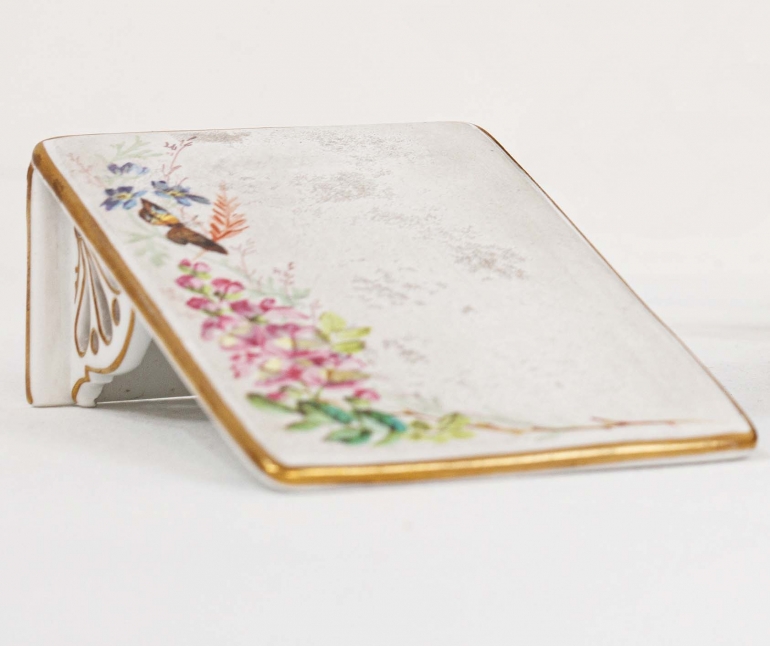
The porcelain floral blackboard from Toumanian's ''universe'' is presented here.
It is a square tile for taking notes (size: 4.5 x 8.5 x 1.5) with a stand. The reverse side of the tile is glazed, and the front side is coated with slipware (a light-colored, finely processed and water-dissolved clay paste) on which notes and illustrations can be made.
The left side of the outer surface is decorated with a multicolored (polychrome) enamel composition consisting of pink lilies, field flowers with blue petals and oval-shaped leaves. It is complemented by a butterfly soaring among the flowers; one wing of which is brown and the other also has patterns of bluish-yellow coloring. A gold band runs along the edges of the tile.
The reticulated leaf-shaped patterns on the "whiteboard" support, belted with a gold-colored strip, made in the manner of artistic carving, are also distinguished.
This eye-catching item decorating the desk of the study of "Vernatun", was used by the poet in a horizontal position to take notes, while in the 19th century it was a unique cultural element of the tableware, an applied and decorative "jewel" in its original meaning (position: vertical) , on which a pre-arranged menu was marked.
We tried to find out where and when it appeared for the first time.
History is proving that the first appearances of writing down the menu were used about 1000 years ago in the “motherland of paper” – China, during the Song dynasty. According to another source, recipes written in hieroglyphs on clay tablets in ancient Egypt were considered the prototype of menu.
The term ''menu'' which has French origin (France: le menu) derived from the Latin word ''minutus'', is considered to be a description of various short lists and resumes. The first prototypes of menu appeared in France from the middle of the 16th century. However, over time, the menu, obtaining a mass character, became the property not only of the royal house and nobles, but also of common people.
The modern style menu has been in use since the 18th century, and in the 19th century the working document of the kitchen was used as a tool to inform customers about the dishes and their prices.
As French chef Fernand Point stated, the menu has three functions ''It pleases the eye, stimulates the appetite, and informs the customer about the expected expenses''.
If at the end of the 18th century the menus in France were beautifully written on the whiteboard and placed at the entrance of the restaurant, later at the beginning of the 19th century individual menus were written too. To satisfy the aesthetic needs of whimsy customers and honorable guests, the famous Parisian restaurants and cafes owners commissioned such prominent artists as Renoir, Picasso, Benoit and others to design the menus.
A guideline ideology for a pedantic approach suggested that ''a restaurant starts with the menu'' or ''the menu is the visiting card of the restaurant''.
Most of the menus were handwritten back then and were made of different materials: cardboard, silk, papier mache, paper lace, porcelain, faience.
Coming back to Toumanian's kitcheware item exhibited in the museum we can assume that it is an example of porcelain produced in Limoges, France. Limoges righteously earned the title of “the capital of porcelain” producing high quality products of luxury. The city acquired fame from the second quarter of the 18th century, after the discovery of the kaolin clay mine (white clay, which is the basis of hard porcelain) nearby the city.
In conclusion we can certainly claim that even today art lovers are attracted to these unique works of art of high artistic value both in private and museum collections.
The "Whiteboard" was a gift to the museum from the poet's family on October 25, 1985. Act № 228, registered in the main fund of the museum: TTGG 996/ WB 2536.
The co-authors of the article

Translated by Anahit Sringyan
