
- Tuesday to Saturday: 10:30 – 16:30
Sunday: 10:30 – 15:30
Closed on Mondays


FROM THE SERIES OF N. LIBERICH “HUNTING SCENCES”
The prominent Russian sculptor of German descent Nikolai Ivanovich Lieberich's (1828-1883) creative heritage symbolizes a very important period in the art history of Russian bronze sculpture.
Liberich devoted half of his lifetime to military service. At first, creating clay and wax characters was just a hobby for the future famous sculptor. However, later he took the matter more seriously and devoting more time to his passion started his education at the Imperial Academy of Art /Императорская Академия художеств/ under the mentorship of sculptor P. K. Klodt. Liberich soon made notable progress and became famous with different circles of society thanks to his professional teacher. In 1861 he was awarded the title of academician for his collection of sculptures called “Hunting Scenes”. Besides the animalistic compositions (bears, dogs, horses, wolves, rabbits and others) and the hunting scenes he also created a series of less famous but exceptionally significant works, which were commissioned by private individuals and by the Imperial Palace.
Liberich created many original compositions, which were later molded into bronze and cast iron. A wonderful horseman and hunter he brought to life his observations in a number of hunting and military scenes and stories illustrated with animals. The traditions of Academic Art School and the ardent passion for nature were mixed with the sculptor’s unique style. Due to the years long military service and observations he developed an eye for minor details in hunting scenes. The sculptor’s vital sensitivity allowed him to carve many realistic sculptures which are reflecting the power, passion and tension of the moment. Besides the hunter he focused his attention to dogs and horses. Analyzing the detailed reflection of animals’ every small muscle and their characteristic poses, Lieberch was well aware of their habits and how their body functioned, gently emphasizing their body structure.
For his creative work the sculptor got a series of well-deserved awards. In 1858 he was awarded with a small silver medal for his history-themed sculpture “Mazepa''. A year later, the sculptor was awarded the title of Honorary Member of the Free Community of the Academy of Fine Arts for his work — "The Death of Graf Rzhetsky."
Frequently, there is a stamp on the statuettes of Liberich—“CAS. 3. 18..” , which means Casley Art Casting Factory (Каслинский завод художественного литья/) and the year of casting. Liberich’s works were casted of cast iron in the Casley Factory for more than a hundred years. His works were also casted in Werfel Factory /Фабрика Верфеля/, Factories of Sokolov, Ovchinnikov and Sazikov, where duplicates of a big number of cast iron and bronze statues were made. The works of the Russian sculptor are mostly in the private collections rather than in the museums. The master’s unique and bright works are of high interest to collectors.
Liberich’s products do not always bear the author's stamp. In that period many works were marked with Factory stamps while the author remained in the shadow.
However, a number of Lieberich's works are clearly distinguished by their features and his surname. Usually the author signed his statues “Н. Либерих” or just “Либерихъ”. Sometimes besides the surname the creation date was also mentioned.
In the 19th century not only the name of the author mentioned on the sculpture, but also that he was the one who created it. There are marks on the sculptures — “Лепило Н. Либерих” or “Лъп. Н. Либерих” — casted on the base of Liberich’s models.
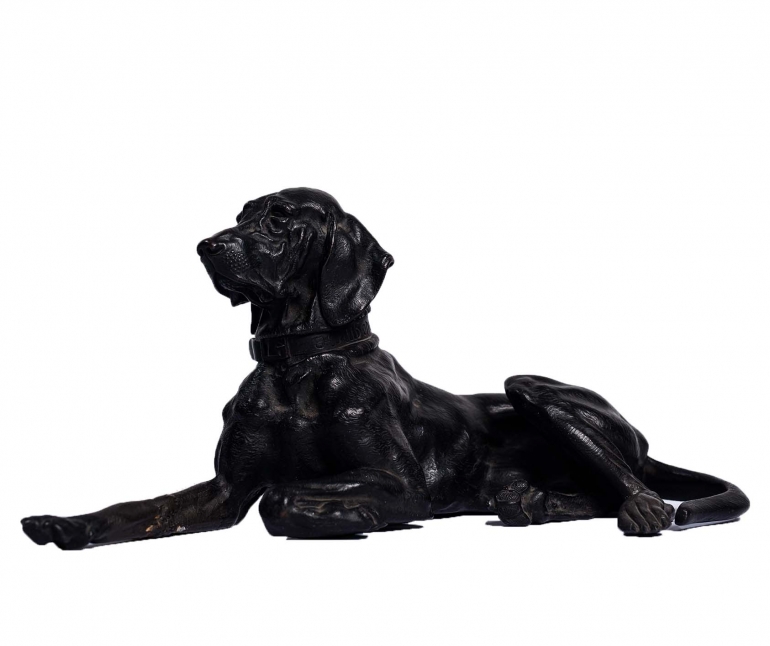
On a small table in Toumanian’s study there is a beautiful collection of statuettes of animals. Two statuettes of Liberich stand out among them, an English pointer breed dog and a killed boar.
1. The Pointer dog statuette
English pointer breed dog: cast iron, molten, hollow (height: 17cm, length: 37cm, width: 17cm, weight: 3kg). The dog is sitting its head up, looking at front of him, right front paw is extended forward, left leg — bent. There is a necklace around the neck, on which the name of the sculptor is engraved in a stylized font. “Н. Либерихъ”. There are two factory stamps under the front left paw. The first is the brand of the foundry – "КАС. З 1888 ", the second is the name of the casting master – “В. САМОЛИН”.
It is a gift from Toumanian’s widow to the museum: Act N5, 25.09.1952.
Registered in the main fund of the museum: ԹԹԳԳ 25 /ՀԲ 22
2. The killed boar statuette
The statuette of a boar: cast iron, molten, hallow (height: 4 cm, length: 18,5 cm, width: 14 cm, weight: 1 kg). It depicts a killed boar lying on its right side. The right side of the statue is cut off, the muzzle, ears, and four legs are depicted almost completely. The hair, eyes, ears and the rest of the body is conspicuously elaborate. Underneath the neck there is engravement — ''Фабр. ВЕРФЕЛЬ'', and on his feet – ''ЛЪП. ЛИБЕРИХЪ ''. It served as a stationery item (presse-papier). to prevent the papers from scattering on the table or flying back and forth.
It is the present of Toumanian’s widow to the museum: Act N5, 25.09.1952.
It is registered in the main fund of the museum: TTGG 36 /WB 32
Article by Anahit Nalbandyan

Translated by Anahit Sringyan
