
- Tuesday to Saturday: 10:30 – 16:30
Sunday: 10:30 – 15:30
Closed on Mondays


TOUMANIANS’ COAL IRON
The question when the first iron appeared in people’s household is hard answered. We don’t even care about it when ironing our clothes. Some people think that the story of the first iron began when fabric cloth production appeared.
According to archaeologists, in ancient times, people used a special polished mammoth bone to iron animal fur. In the 4th century BC in Ancient Greece was discovered the technique of giving small stacks to fabric made clothes, with the help of a rolling pin form hot metal rod. In ancient times heated cobblestones were used for ironing too. Before the advent of the iron in Russia, the fabric was ironed using a frying pan heated on coals, a device made of a corrugated wooden board and a roller. The thing to be ironed was wrapped in a rolling pin and rolled on a board. The first mention of iron is found in the book of expenses of the Russian palace. The note was made on February 10, 1636. Irons that coasted five gold coins had the simplest type of heating. It weighed 10 kilograms and was monolithic.
In the 16th century metal hot sheets were used for ironing, in Europe, which makes it easy to smooth out the folds. Glass balls filled with hot water or iron metal cups were used to smooth things out.
First metal irons appeared later when special care needed pleats and tapes became widely used. In that period such irons were quite expensive. Decorated with magnificent ornaments they were demonstrated to the guests, along with samovars. An iron in the house emphasized the wealth and welfare of the house's owner. In the 18th and 19th centuries irons were metal-clad objects and they looked like today's irons. In ancient times, irons were made mainly of cast iron or other heavy metal. Heated irons were more common; they were put on the stove and heated. In the middle of the 18th century, the coal iron appeared which had an open lid in which burning coal was poured.
In the 19th century, German craftsmen created the first alcohol irons. They figured out that on the top of the iron could be fastened a small tin vessel filled with alcohol that released a small amount of heat, resembling an oil lamp. Because of the lack of alcohol, such an innovation did not exist long. For a long time, irons were not available to everyone; they were considered a luxury, instead of an iron one could buy a whole flock of sheep. Alcohol irons didn’t exist long in Russia too, because the price was high – 10 rubles, while one could rent a flat for 5 rubles in Moscow, and an ordinary cast iron coasted 1 ruble.
Almost at the same time gas irons appeared, which looked like a small factory. There was a switched burner inside the iron, connected with a small fuel tank; a vent pump was installed on the cover, which was easily pressed with a wrench during ironing. Before ironing one should heat the tank, and then the steam was pumped into the burner. The next step was making a spark and one could start ironing.
There were also aluminum irons which were created not for ironing but for exporting non-ferrous metal. With the invention of electricity and the development of technology, the production of electric irons began. The principle of operation of such irons is based on the generation of thermal energy during the passage of electricity. As a rule, the structure of the iron ensures that the heating element is as close as possible to the base, and the handle made of heat-insulating material, to avoid burns.
The irons in Russia were produced in the 18th century in the Demidov factory. The first device made by craftsmen at that time was with an inset; it was heated up and put in an iron. The coal iron, which should be heated before ironing, was famous enough: the lid opened and burning coal was placed in it. It was quite heavy.
A large collection of irons (more than 150) is kept in the “Radomisl Fortress” historical-cultural complex in Ukraine.
A private museum of iron is in Pereslavl Zaleski city, Yaroslavl province, Russia. The museum is dedicated to the history of household irons from the 18th to the 20th century. In the collection of the museum there are more than 200 irons of seven different types: heating iron, cast iron with heating core, coal iron, steam iron, alcohol iron, gas iron, electric iron.
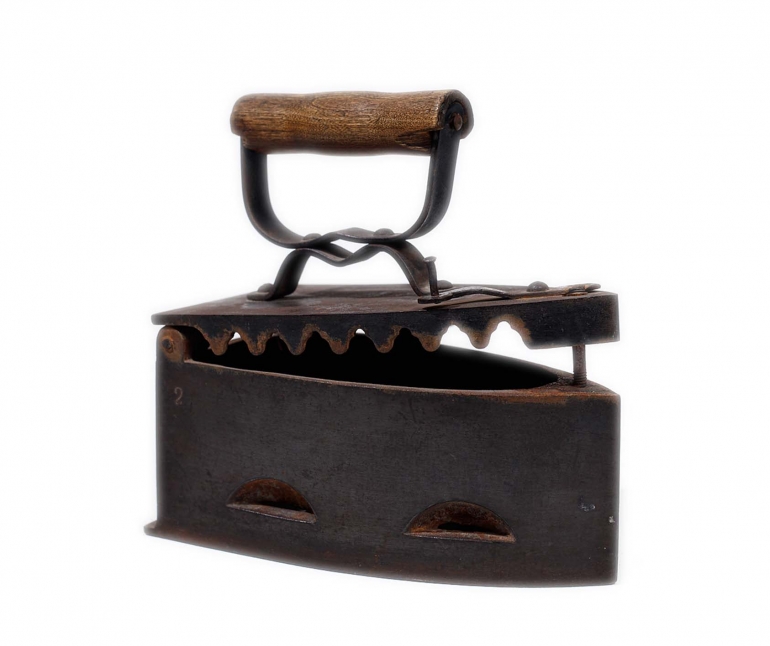
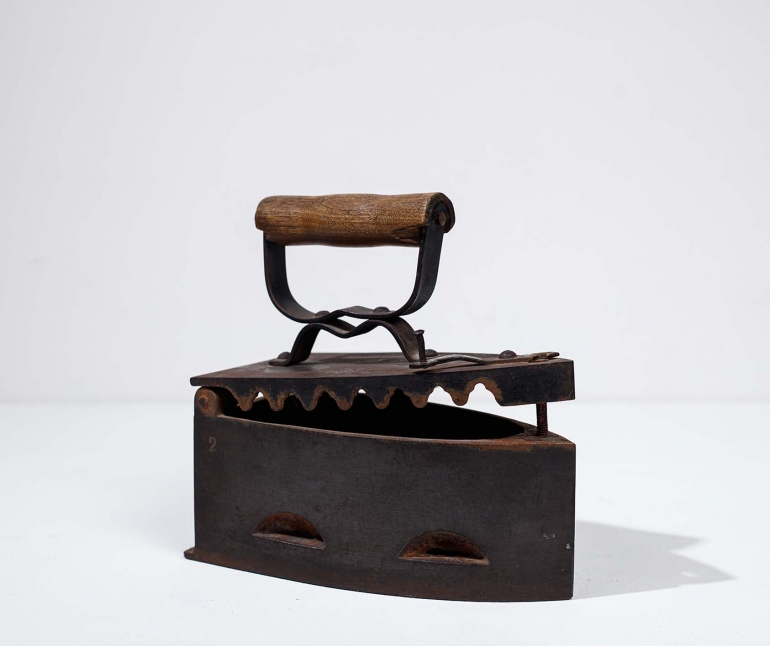
In the house of Toumanians – progressive in everything, there were a lot of things contributing to improve life, among them there was a coal iron helping Mrs. Olga to provide a tidy and clean look of the family. Mrs. Olga's pre-Soviet iron, unfortunately, did not survive. The Soviet-made iron which was obtained later is exhibited in the veranda of Toumanian’s house.
The iron made of cast iron, the weight is 3.978g. The height is 21 cm, the length is 21.8 cm, and the width is 10.8 cm. The iron has the shape of a sharp nose boat, with high walls, at the bottom of which there are horizontal arched cracks, two are on each of sides and the one is on the back. On the right wall of the iron /to the back wall/ the digit “2” is engraved. The lid is retractable with serrated edges and a latch on the nose. On the inside of the lid the name of the factory was engraved; “Подольский государственный механический завод” (Podolsk State Mechanical Factory) and number “4”, therefor the iron was produced in the city of Podolsk in Moscow region, USSR, is dated 1930-1950. There is a fixed latch under the crack in the back wall too. It has a tape handle made of metal rod with a wooden cylinder handle, which is fastened with screws to the iron cover.
On February 19, 1975 the family of Toumanian presented the iron to the museum (act N 156). Registered in the main fund of the museum: TTGG 728/WB 826
Article by Anahit Nalbandyan

Translated by Anahit Sringyan
