
- Tuesday to Saturday: 10:30 – 16:30
Sunday: 10:30 – 15:30
Closed on Mondays


WATANABE OSAO. SAMURAI
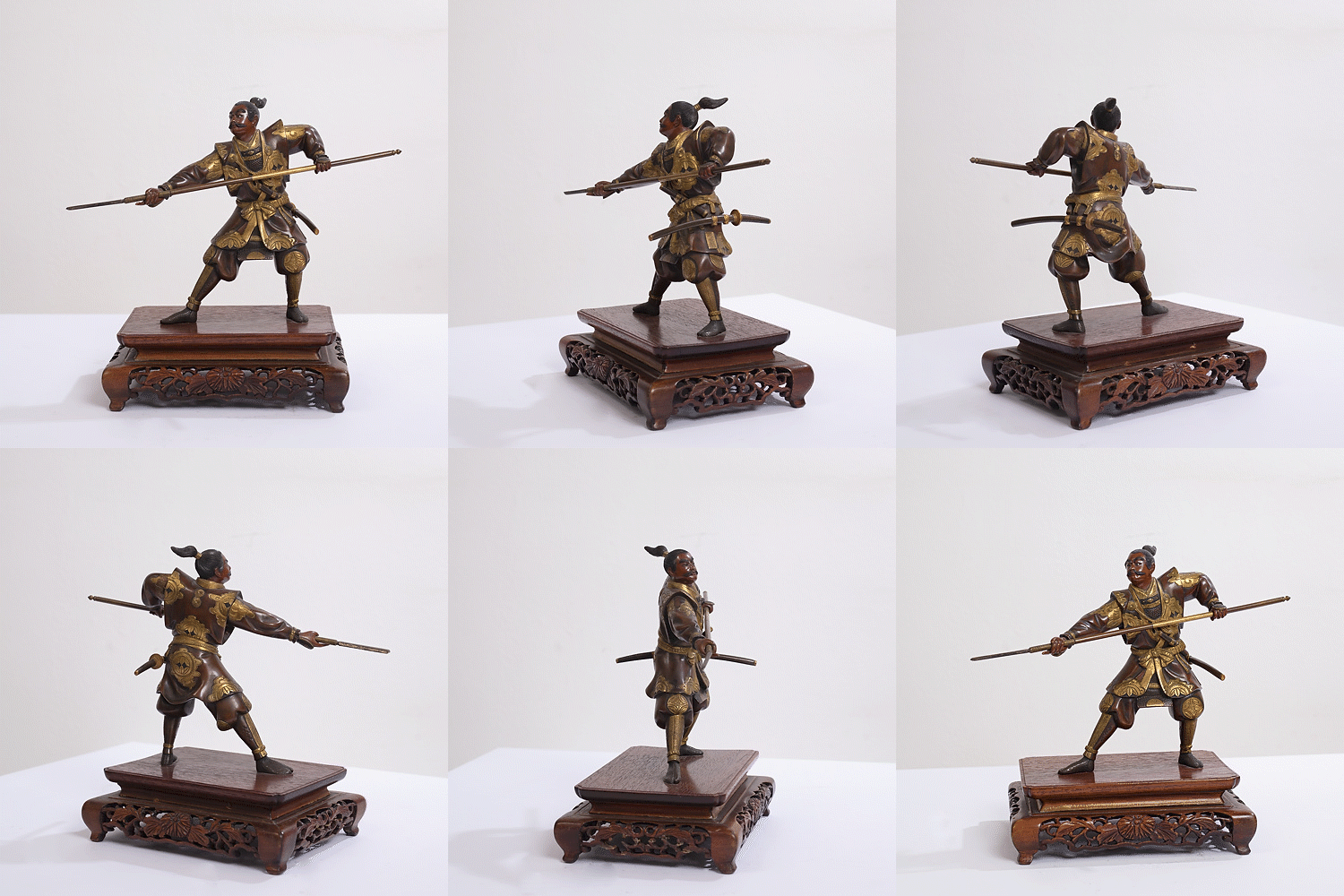
In her memoirs Nvard – Hovhnnes Toumanian's daughter – remembers that the poet preferred to live in the Oriental style during the final years of his life while actively writing quatrains.
The beautiful and high-quality decoration of his room, with various Japanese, Chinese, Persian paintings, statues and other beautiful objects of Oriental culture proves this. These decorations reveal Toumanian’s Oriental aesthetic perceptions and preferences. Among them there is a "delegate" of the Far East, from the "Land of the Rising Sun" — a statue of samurai. It has an essential meaning from the historical-artistic point in the context of communicating with the Japanese decorative-practical art, revealing and presenting the centuries-old subculture of the samurai.
Like the blossoming sakura (blossoming cherry-tree) and ikebana (flower art), Non (the ancient type of Japanese theater) and Ukiyo-en (woodcut or xylography), the samurai class and bronze sculptures are the best characteristics of the Japanese national identity and traditional aesthetics.
To study the statue, it is important to briefly go back to the history of the samurais’s origin.
The term "samurai" (Japanese: 侍) is derived from the word "saburau" (Japanese: 侍 ふ), which means “to serve”. This class of Japanese society emerged as a result of the Taika Reforms (646) initiated by Prince Naka-no-oen (Japanese: 大化 の 改 新). If at the beginning of their existence they were called to serve the members of the Imperial Palace, then since the 12th century in feudal Japan ruled by the Shoguns (commander-in-chief of the samurai administration), they became the country's military elite. At the same time, on the basis of Confucianism, a regulation was formulated summarizing their moral code — "Bushido" (translated as "Fighter's Path"). Among the principles are honesty, courage, mercy, education, modesty, justice, devotion, loyalty, etc.
Starting from the 17th century, during the Edo period (1603-1867), the country was in a long-lasting peace and stability established by the shogun Minamoto-no Yoritomo. During this period the martial arts had lost their importance, samurais mostly appeared as mentors, artists and poets or statesmen. On this occasion the following proverb was formed: "Fujiyama stands out in the mountains, the samurai stands out among the people."
In the 19th century, during the Meiji period, samurai lost their authority and united with other social classes. However, their influence is still significant in Japanese culture, particularly in modern martial arts.
The bronze statuette in Toumanian’s personal collection makes the collective image of samurai even more vivid. It is a small-scale work belonging to the "Okimono" type of decorative sculpture with its ideological-artistic solutions. These items were designed to decorate “tokonomas” or worship corners in a traditional Japanese apartment.
The Okimonos were distinguished with their plot variety, from the incarnation of gods and historical figures (Buddha, Confucius, Bodhidharma) to images of nature and everyday life. They were mostly made of wood, ivory, bronze, silver, or often a combination of both.
This type of decorative-practical art became popular in Japan after the Meiji Revolution (1867–1912) (Japanese.: 明治維新, Meiji Ishin). The feudal country of Emperor Mujihito, under the pressure of Europe and USA, came out of self-isolation and entered a phase of liberalization and modernization. In this period of radical reforms, thanks to the resumption of trade relations with the world, the leading Japanese metallurgical masters (Miyao Eysuki, Akasofu Gyoko, Yoshimitsu, Osima Dyo, Suzuki Tyokiti) and existing workshops (Komayi (駒井), Miyao (宮尾),Nogava(能川),with their high quality metal and original designs (vases, dragons, soldiers, etc.) were able to create a high demand among European and American consumers, making previously undiscovered traditional Japanese culture of thousands years old well-known to the outer world.
Instead of the masters’ signature, the products meant for the external market are often marked with labels of individual clients or client companies. Meanwhile, according to the unwritten local law, in avoidance of excessive ostentation, decorative-applied products produced for the national elite were usually not labeled. According to another tradition the masters used to stamp their nicknames, which could be changed several times during their creative lives. On the foot of the figurine in Toumanian's studty, we can see a writing composed of the following hieroglyphs: 渡 邊 製, the translation from Japanese – “Made by Watanabe”.
It is supposed to be the same Japanese sculptor Watanabe Osao. He was born on April 2, 1874 in the family of sculptors, in the Oita prefecture, Kyushu region, Japan. In 1903 he graduated from Tokyo Art School. Right from the very start of his creative life, Watanabe Osao stood out from others for his innovative abilities. Unfortunately, during WWII in Imperial Japan, along with other bronze artworks the works of this master were also melted.
In the late 19th and early 20th centuries, a series of bronze sculptures representing national heroes, particularly the samurai martial arts and their traditions, aroused great interest at the World Industrial Exhibitions. According to some sources, the prototype of such samurai castings was the work of Miyao Eysuki, the founder of the Miyao factory, which was made by bronze casting, embossing and engraving.
The samurai statuette belonging to Toumanian is from that category. The author of the work presented the samurai standing in a combat position, holding a sharp spear in his hand and his legs are wide open. The clothes made of dark bronze are decorated with gilded patterns. It is a circle in which we see the stylized image of bamboo, the symbol of eternal youth and power. It is called Take-mon (竹 紋) or Kaka-mon (笹紋) in Japanese. "Mon" or "kamon" are the common symbols of the various socio-cultural strata of Japanese society (aristocrats, samurai, priests, geishas, craftsmen, actors and merchants).
There are about 240 symbols with more than 5000 different types and 6 main themes. The laconic shaped chambers, two-color stylized images of philosophical categories, natural phenomena, animals, plants and flowers, weapons and armor. They are stamped on clothes, weapons, curtains, armchairs, other personal items, even as tattoos on the body.
It was during the Emperor Genrocu’s era when luxury became a priority, and this art became more widespread. With some interruptions, the interest in it has increased since World War II, appearing in the symbols of various companies no matter large and small. Interestingly, in modern-day Japan there are still specialized stores where you can buy embroidered clothes or a pendant made directly by the customer.
Coming back to the ideological-artistic description of the figurine we should pay attention to the outfit of the samurai. There are two dark brown kimonos on the figurine. Long sleeved kimono is under the pants (hakama). The length of these pants was regulated by the straps in the hips, as a result of which the pants got a sack-like shape at the knees. At the feet of the figurine we see a tabi (traditional Japanese socks) whose thumb is separated from the other toes, or a dzika-tabi (they are the same socks, however, made of a more durable material). On the ornate armor that protects the samurai's chest, there is a gold-plated jacket that highlihts the shoulders and covers his thighs. It is attached to the waist with a belt (obi) so that wings are formed on two opposite sides. The belt is one of the most functional elements of clothing. In the middle of the waist there is a short knife (syoto) for self-defense or suicide (harakiri), and a long sword (daito) hanging from the side. From ancient times the sword was considered sacred and “devoted” by the Japanese goddess Amateras for righteous deeds. In the hand of the figurine there is a sharp spear (su-yari). The average length of a spear was 2-3 m, and spears designed to protect from cavalry - up to 6.5 m. One of the components of the outfit is the leggings that protect the calves, which are gilded. The face expression of the samurai figurine covered with dark enamel is strict and combative. He has thick eyebrows and a mustache. Black, tight ponytail at the back of the head is strapped with a gilded ring. The samurais also stood out with their hairstyles (sakaki, kobin, horse, debitai, etc.). Before the Meiji Revolution, haircut was an indicator not only for different socio-cultural strata of society, but also for social status within the same subgroup, and any deviation from the established rules could bring severe punishment.
To complete the description, it should be noted that the samurai figurine is fastened to red wood two-storied pedestal with a screw (the length of the upper part is 16,5 cm, the width is 11,5 cm, the length of the lower part is 18 cm, the width is 13,5 cm, total height is 17 cm lower part), the upper part of which has a flat surface, and the small one is decorated with carved floral patterns.
The figurine also has a rectangular wooden box with a retractable lid, which is attached to the box with two metal hinges. It is covered with smooth paper on the outside and red-blue on the inside. The figurine is placed in a special niche. In front of the box a metal valve is attached in the form of a heart shaped leaf (the size of the box is 13x29x17 cm).
It is registered at the main found of the museum TTGG840/ WB913.
Acquired from the poet's family, Act N184, 28/09/1978, price: 800 rubles.
The co-authors of the article


Translated by Anahit Sringyan
