- Tuesday to Saturday: 10:30 – 16:30
Sunday: 10:30 – 15:30
Closed on Mondays


HOVHANNES TOUMANIAN'S ROBE
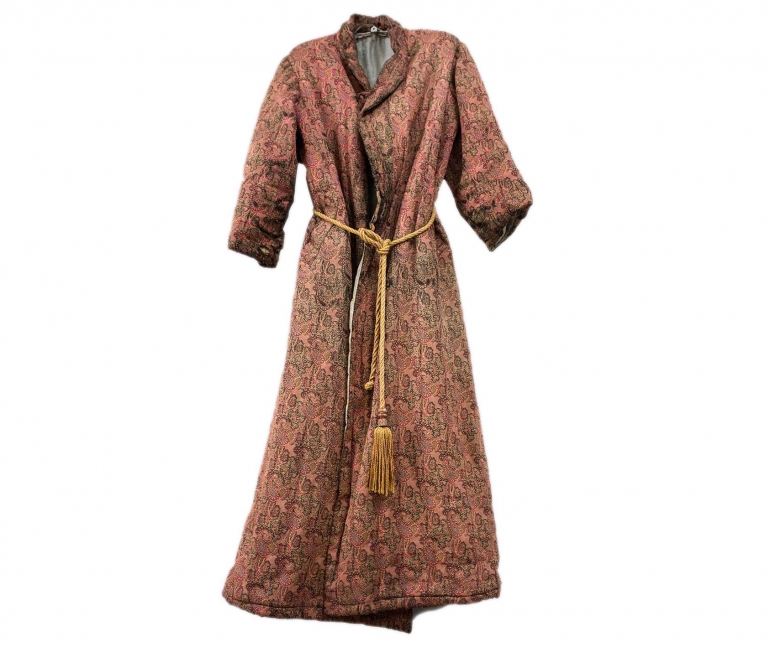
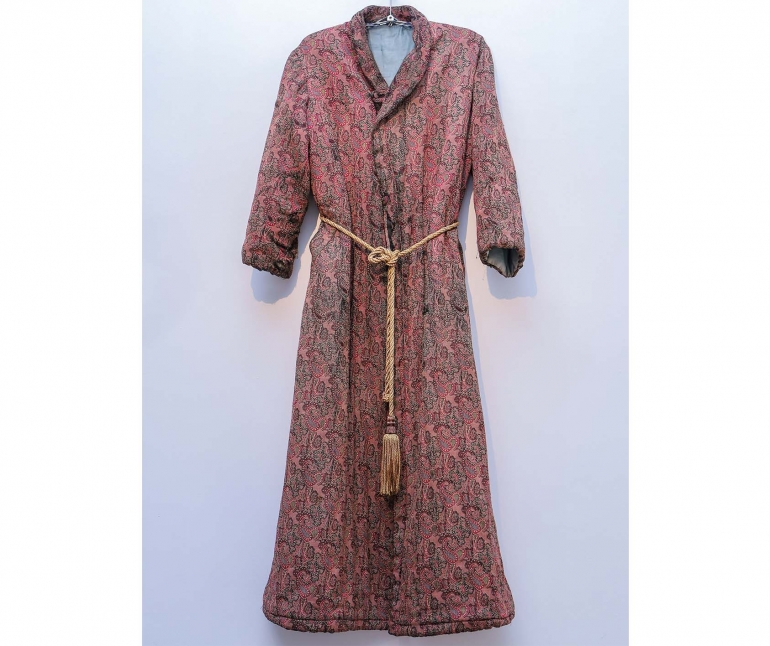
For Toumanian, his robe was a reliable way to protect him from the cold. In the last years of his life, his health had worsened enough and Toumanian was inseparable from his warm oriental robe. The beauty of the robe was not inferior to its convenience. Toumanian was a man of a high taste and exquisitely combined his garments. Nvard . Toumanian mentions in her notes "In winter he wore a Kirman shawl, long and wide ...". Preserved in . Toumanian's Tiflian apartment is a burnt-out love photograph of the poet and Nvard, taken on his fiftieth birthday (1919 February 19), where Toumanian was wearing this particular robe (photographer Mushegh . Toumanian ).
The robe is widely used in the Middle and Far East as a garment. The word robe is a loan from an Arabic word خلعة (xil 't) and from the Persian word خلعت (xel' at) and means "As if the garment had received an award." In the old days, the owners of the East,as a sign of their satisfaction, presented robes to those who deserved them. A thin and long robe protected from the rays of the sun during the day and from the cold during the night. The Toumanian's robe was a real oriental robe without a refined waist so that you could wrap yourself up in it. The sleeves were made in an Asian style and were wider around the shoulders. The collar of the robe is foldable and a circular merak and button are attached to it. The factory-made product retained its vibrant oriental colors and fabric durability. Soft and comfortable. Sewn from Persian terme fabric (Pers. ترمه) which is represents a delicate woolen fabric. To obtain a quality fabric, you need a good wool with long fibers. In the production of this fabric, it was mainly Isfahan region that was praised. The quality of terme has always fascinated everyone, from Greek historians to today's fashion houses. Today there is a great demand for the handmade termen produced in Yazd.
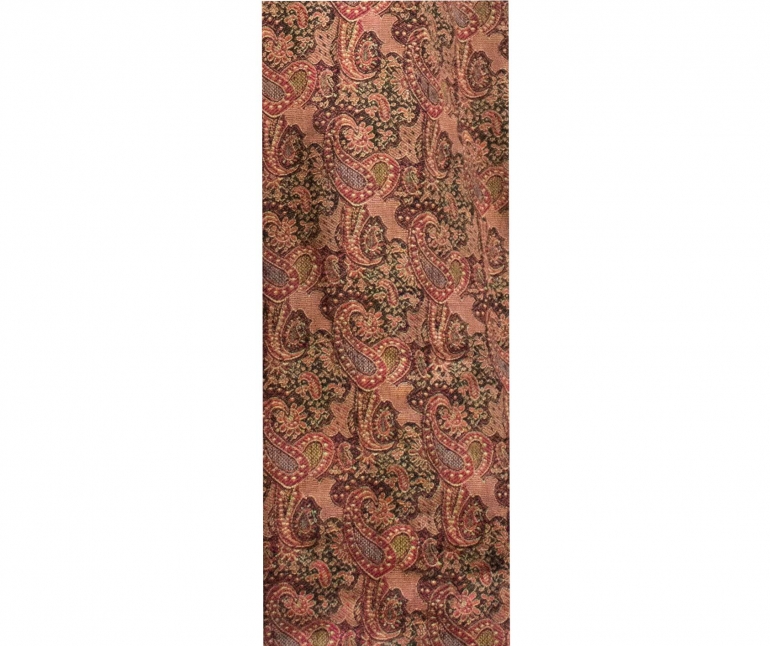
The fabric of Toumanian's robe has almond-shaped floral patterns on it, with one-sided sharpening and curled edges. which are called bote (Pers. بته).The pattern is oriental, but it is not known where and when it was first applied. Some researchers find that the pattern is based on the symbol of life and infinity from Zarathust 's. Others simply compare its resemblance to a feather, pheasant, or almond. In Hinduism, this pattern, which resembles a seed, personifies fertility. The pattern is even somewhat similar to the famous Yin and Yang symbols.
The floral version of the pattern appeared in the Sassanid period. And it began to be widely used as a pattern for fabric during the Ghajar period, reaching our days and having a high use in Eastern fashion. At that time, the Persian court and the nobility wore terme robes that were decorated with buta patterns. In the 15th century, Buta penetrated from Persia to Kashmir, which was famous for its shawl production. It has become widely used in decorations. And it was from here that the pattern penetrated into Eastern culture because English vendors from India imported cashmere shawls to England. Toumanian's robe has a belt in the form of a rope sewn with yellow silk threads, with fringed edges. The inner part of the robe is covered with blue satin.
The poet's wife donated the writer's robe to the museum in 1952 on September 25 in accordance with Act N5, which is registered in the main fund of the museum: TTGG 181 / WB 120.
Article by Vardanoush Nalbandyan Translated by Mery Azaryan